
At thirty, Rembrandt van Rijn was the most fashionable painter in Amsterdam. At fifty he was bankrupt, his house and his collection sold at auction, his wife and three of his four children dead. In the years that followed, living in a rented house in a poorer part of town, he painted the pictures most people now consider his greatest.
It is one of the strangest arcs in the history of art, and it explains a great deal about why his late work looks the way it does.
The miller’s son
He was born in Leiden in 1606, the son of a miller. He went briefly to university, left to train as a painter, and by his early twenties was working in Leiden alongside his friend Jan Lievens, painting small, intense pictures and an endless series of studies of his own face.
In the early 1630s he moved to Amsterdam, then the richest city in Europe, and success came fast. The picture that made his name was The Anatomy Lesson of Dr. Nicolaes Tulp, painted in 1632 when he was twenty-six. Group portraits of guilds and societies were usually stiff rows of heads; Rembrandt made his into a scene, with the surgeons leaning in to watch a real demonstration. Commissions poured in.
Saskia, and the house on the Breestraat
In 1634 he married Saskia van Uylenburgh, the cousin of the art dealer he worked with. She brought a substantial dowry and good connections, and she appears in his work again and again — as Flora, as a bride, as herself.
In 1639 they bought a large house on the Sint Antoniesbreestraat, in what is now the Rembrandthuis museum. The price was enormous, and Rembrandt paid only part of it, leaving the rest to be cleared over years. Meanwhile he spent heavily on his collection — paintings, prints, armour, shells, Roman busts, costumes, exotic objects. Many of them turn up in his pictures, including the glittering, theatrical Belshazzar’s Feast, with its writing appearing on the wall.
1642
The year everything started to go wrong was 1642. It was the year he completed The Night Watch, his huge group portrait of a civic militia company, and the year Saskia died, not yet thirty. Of their four children, only one, Titus, survived infancy.
There is a popular story that The Night Watch was a failure that ruined him, because the members of the company were unhappy at being lost in the shadows. It is mostly a myth. The painting was accepted and paid for, and was admired at the time. It was not even a night scene — layers of darkened varnish made it look like one, and gave it the name in the eighteenth century.
But his circumstances were changing anyway. Fashion was moving towards brighter, smoother, more elegant painting, and Rembrandt was moving in the opposite direction — rougher, darker, more personal. He was also a famously difficult client, and he kept spending money he did not have.
Bankruptcy
In 1656 he applied for cessio bonorum, a form of insolvency that let a debtor surrender his property to avoid prison. Officials drew up an inventory of everything in the house, room by room, which survives and tells us exactly what he owned. Over the next two years his collection and then the house itself were sold off, for far less than he had paid.
He moved with Titus and his partner, Hendrickje Stoffels, to a rented house on the Rozengracht in the Jordaan, a working-class district. Because of guild rules, an insolvent painter could not trade freely, so Hendrickje and Titus set up an art-dealing business and formally employed him. It was a way of keeping him working.
The late work
What he painted next is extraordinary. The surfaces get thicker — paint trowelled on with a palette knife, dragged with the handle of the brush, built up until it almost stands off the canvas. The colour narrows to golds, reds and browns. The subjects become fewer, quieter and more human.
The Syndics, from 1662, shows five officials of the drapers’ guild, with their servant behind, looking up from their table as though someone has just walked in. It is a commission, but there is nothing stiff about it.
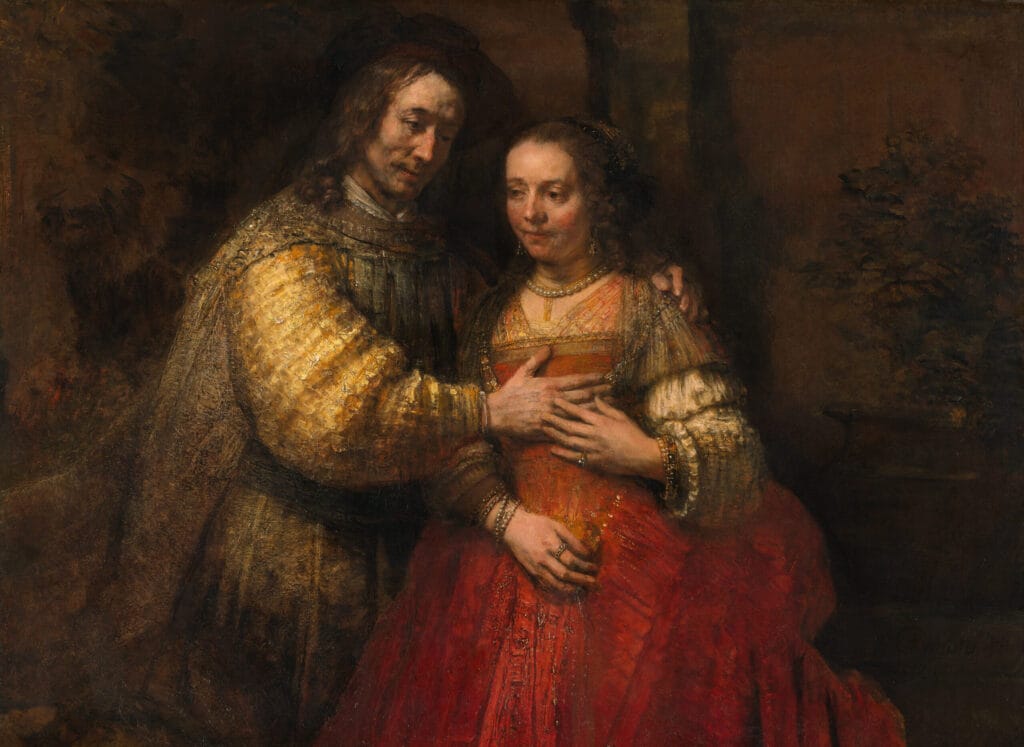
The Jewish Bride, painted in the mid-1660s, is two people standing close, his hand resting on her chest, hers resting on his. Nobody is quite sure who they are. Van Gogh, seeing it in the Rijksmuseum, said he would give ten years of his life to sit in front of it for a fortnight with only a crust of bread.
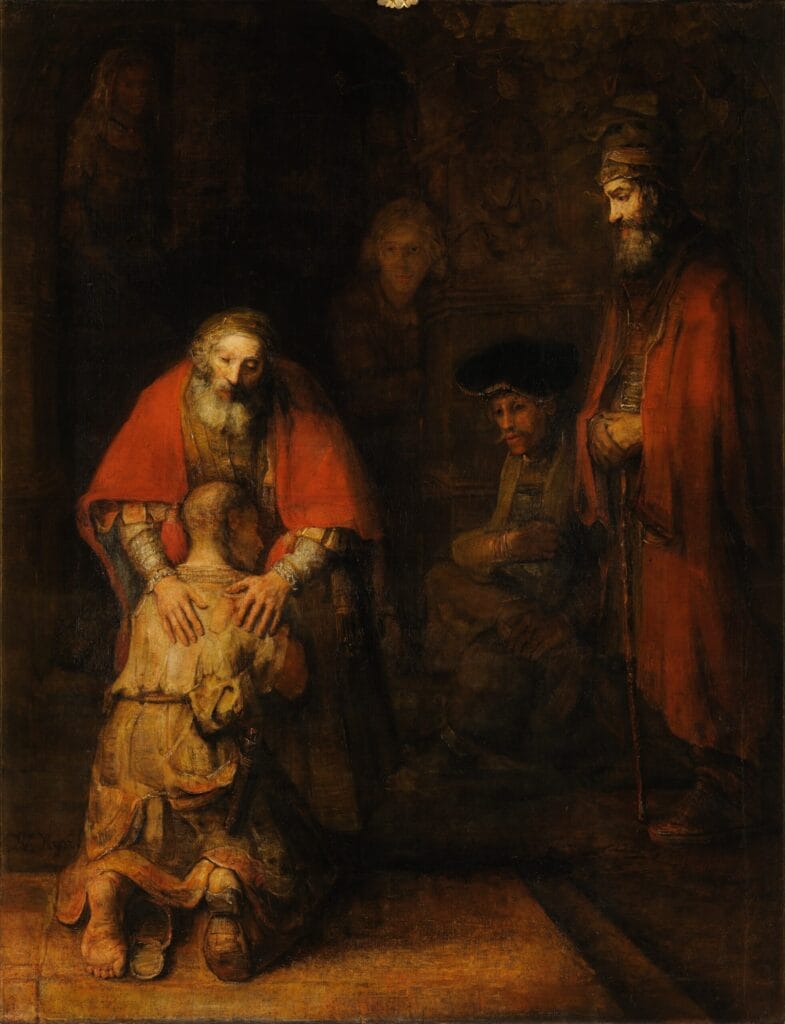
The Return of the Prodigal Son, from the last years of his life, is perhaps the most moving. The ragged son kneels with his shaved head pressed against his father; the old man’s hands rest on his back, one broader and one finer. There is no drama, no lesson, only forgiveness.
The end
Hendrickje died in 1663. Titus died in 1668, aged twenty-six, months after his wedding. Rembrandt died the following October, in 1669, and was buried in a rented grave in the Westerkerk whose exact position is no longer known.
He painted himself almost to the end. The late self-portraits, like Self-Portrait with Two Circles, show an old, heavy, unflinching face looking straight out, with nothing to prove and nothing to hide. They are among the most honest pictures anyone has ever made of themselves.
Why the late work matters
It would be too neat to say bankruptcy made him a great painter. He was already a great painter. But losing the house, the collection and the fashionable clients seems to have freed him from having to please anyone, and the late work has a directness that the confident early pictures do not.
It also explains why his reputation dipped after his death, when collectors wanted polish, and soared in the nineteenth century, when painters started to value exactly that rough, personal handling.
Which Rembrandt for which room
Rembrandts want warm, low light and deep walls — dark green, oxblood, charcoal — where their shadows can merge into the room.
The Return of the Prodigal Son at 36 by 46 inches and Belshazzar’s Feast at 46 by 37 sit in Myth & Devotion. The Jewish Bride at 50 by 36, The Syndics at 50 by 33 and The Night Watch at 48 by 40 are in Portraits & Figures, alongside the late Self-Portrait with Two Circles.
The Jewish Bride is the one for a bedroom. The Prodigal Son is the one for a quiet room you sit in at the end of the day. It is hard not to think he painted it partly for himself.