
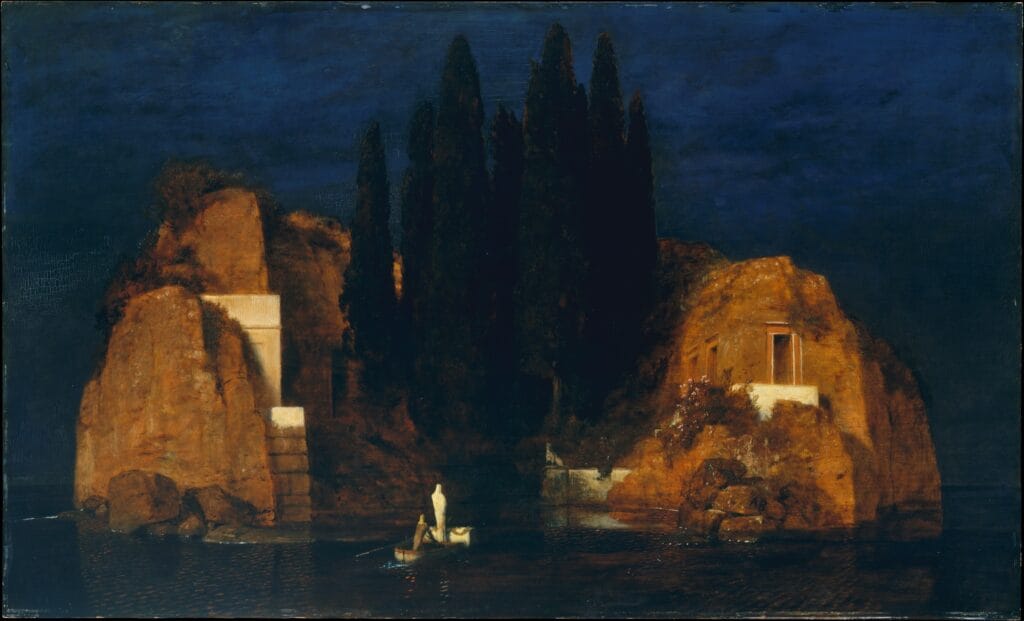
Around 1900, if you walked into a respectable middle-class home in Berlin, there was a good chance you would find the same picture on the wall: a small rocky island rising out of black water, ringed by cypresses, with a rowing boat approaching carrying a figure wrapped in white. Vladimir Nabokov wrote that a reproduction of it could be found in every Berlin home.
The painting was Isle of the Dead, by the Swiss painter Arnold Böcklin, and for a few decades it was one of the most popular images in Europe. Its story involves a young widow, five different versions, a composer, a dictator and a title the painter never chose. It seems the right picture for the end of October.
Arnold Böcklin
Böcklin was born in Basel in 1827 and spent much of his life in Italy. He painted mythological scenes full of nymphs, centaurs, sea creatures and gods, but set in landscapes that feel real — rocks you could climb, water you could swim in. He belonged to the movement later called Symbolism, which tried to paint moods, dreams and states of mind rather than events.
His personal life was marked by loss. Of the fourteen children he and his wife Angela had, eight died young, and he lived with death closer than most. In the late 1870s the family were living in Florence, near the English Cemetery, where one of his daughters had been buried — a small island of cypresses and tombs in the middle of the city, which is often suggested as one of the sources for the painting.
A picture to dream by
In 1880 Böcklin was working on the first version of the picture in his Florence studio when he had a visitor: Marie Berna, a young widow. According to the usual account, she asked him for a painting to dream by.
He made her a second version, smaller, and added a detail: the shrouded figure in the boat and the coffin in front of it. Many people have read the figure as Berna herself, crossing to visit her husband. Böcklin returned to the first version and added the figure there too.
He did not call it Isle of the Dead. He called it simply a picture for dreaming, or used neutral descriptions. The title Die Toteninsel was given by his dealer, Fritz Gurlitt, in 1883, and it stuck.
Five islands
The picture was so successful that Böcklin painted it five times between 1880 and 1886. The island, the cypresses and the boat stay roughly the same, but the light, the time of day and the mood change from version to version.
The first is now in the Kunstmuseum in Basel. The second is in the Metropolitan Museum in New York. The third, from 1883, is in the Alte Nationalgalerie in Berlin. The fourth was destroyed during the Second World War and survives only in a black-and-white photograph. The fifth, the darkest and most sombre, was commissioned by the Leipzig museum and is still there.
Alongside the paintings, there were etchings, photographs and cheap prints by the thousand. That is how the image reached all those Berlin living rooms.
Rachmaninoff’s black and white island
In 1907 the Russian composer Sergei Rachmaninoff saw a black-and-white reproduction of the painting in Paris. It made such an impression that he wrote a symphonic poem of the same name, which premiered in Moscow in 1909. The music has a rocking 5/8 rhythm that suggests oars moving through slow water, and it builds to a long, swelling climax before sinking back.
There is a well-known postscript. When Rachmaninoff later saw one of the original paintings in colour, he is said to have been disappointed, and to have remarked that if he had seen the original first, he might never have written the music. The grey of the reproduction was what had moved him.
A painting everyone wanted
The image attracted an unusual range of admirers. Giorgio de Chirico, whose eerie empty piazzas helped inspire Surrealism, owed a great deal to Böcklin’s mixture of the real and the uncanny, and Salvador Dalí later painted his own variations on the island.
It also had a darker afterlife. In 1933 Adolf Hitler bought the third version, which he hung first at the Berghof and later in the Reich Chancellery in Berlin. It is a reminder that images do not choose their owners. After the war the painting went to the Alte Nationalgalerie, where it hangs today.
What is actually in the picture
It is worth looking slowly. The island rises sheer from the water, its cliffs cut with doorways and openings that look like tombs. Tall cypresses — the traditional tree of Mediterranean cemeteries — fill the centre, dark and still. The water is perfectly calm.
The little boat is rowed by a figure facing away from us. Standing at the front is the shrouded figure in white, and in front of it, a coffin draped with a garland. We never see a face. The picture never tells us who is arriving, or why, or whether anyone will come back.
That is a large part of its power. It is not frightening the way a horror image is frightening. It is quiet, inevitable and strangely peaceful — much closer to the feeling Marie Berna asked for than to anything gothic.
Living with the Isle
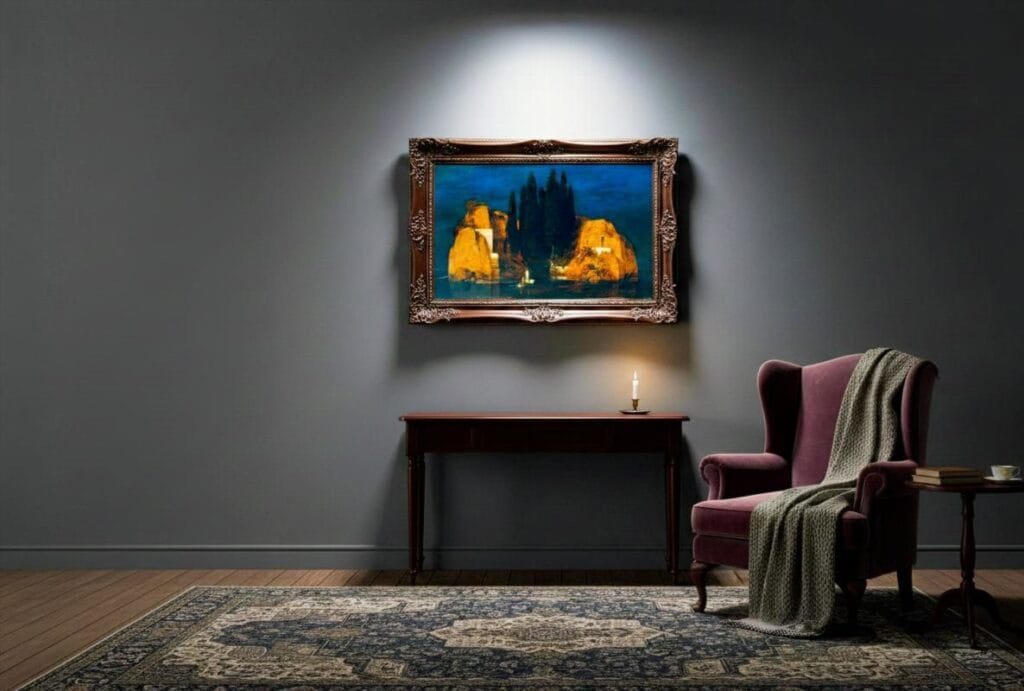
It might seem an odd picture to hang at home, but its popularity a century ago suggests otherwise. It is a meditative image rather than a morbid one, and in the right room it has the calming effect of a still landscape.
Isle of the Dead is 43 by 26 inches, a horizontal, and it sits well in a study, a reading corner or a bedroom. The palette is deep blue, black and stone, so it suits dark or muted walls — slate, inky blue, charcoal — and low, warm lamplight. It is in Landscape & Seascape.
For other quiet, atmospheric landscapes in the same spirit, Wanderer above the Sea of Fog and The Fighting Temeraire make good companions. All three are about endings, in their own way, and none of them is sad.
A quiet picture for the end of October.