
In 1894 a painter from Kerala opened a printing press in Bombay, and within a few years the gods of Hindu households had a common face. Not a face from scripture or temple sculpture, but one drawn from a specific man’s imagination, printed in colour, and sold cheaply enough that almost anyone could own it.
The painter was Raja Ravi Varma. The press lost money, moved twice, and was eventually sold off. It is the most consequential failure in Indian art.
The letter that started it
The idea was not his. Sometime in the 1880s, T. Madhava Rao — the former Dewan of Travancore — wrote to Varma pointing out the obvious: demand for his work far exceeded what one pair of hands could paint. Send some of your best works to Europe, he suggested, and have them made into oleographs.
It took a decade to act on. In 1892 Varma imported steam-driven lithographic machinery from Germany and brought over two German technicians, Fritz Schleicher and B. Gerhardt, to install and run it. The press opened in Girgaum, Bombay, in 1894, financed in partnership with a local businessman, Govardhandas Khatau Makhanji. Varma’s brother, C. Raja Raja Varma, handled much of the logistics.
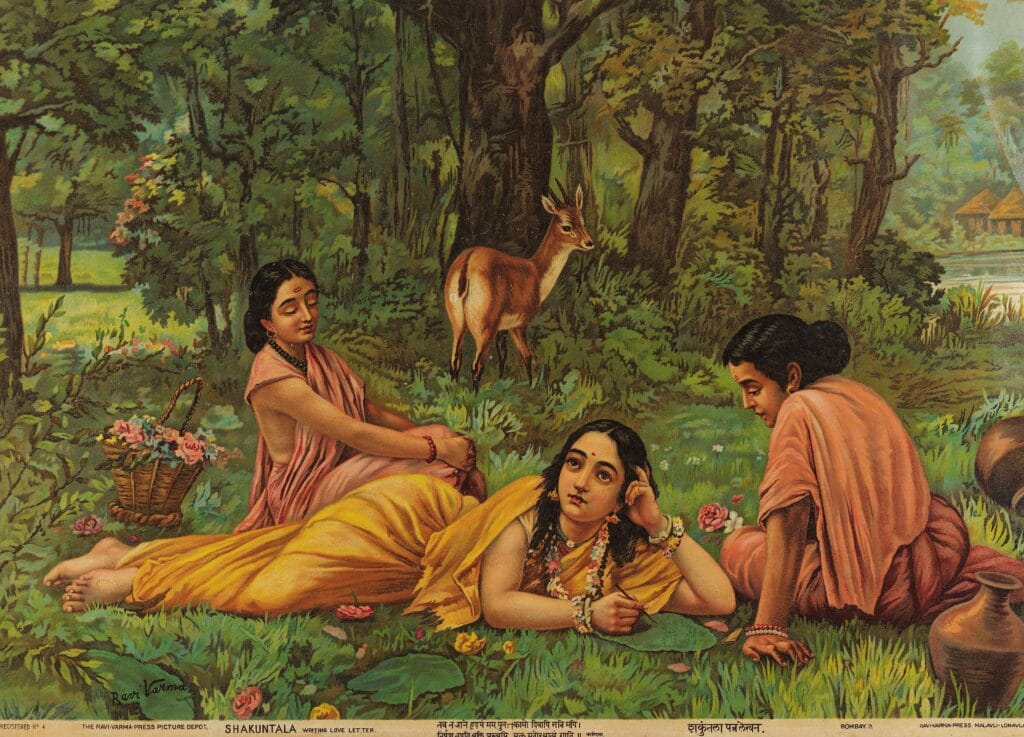
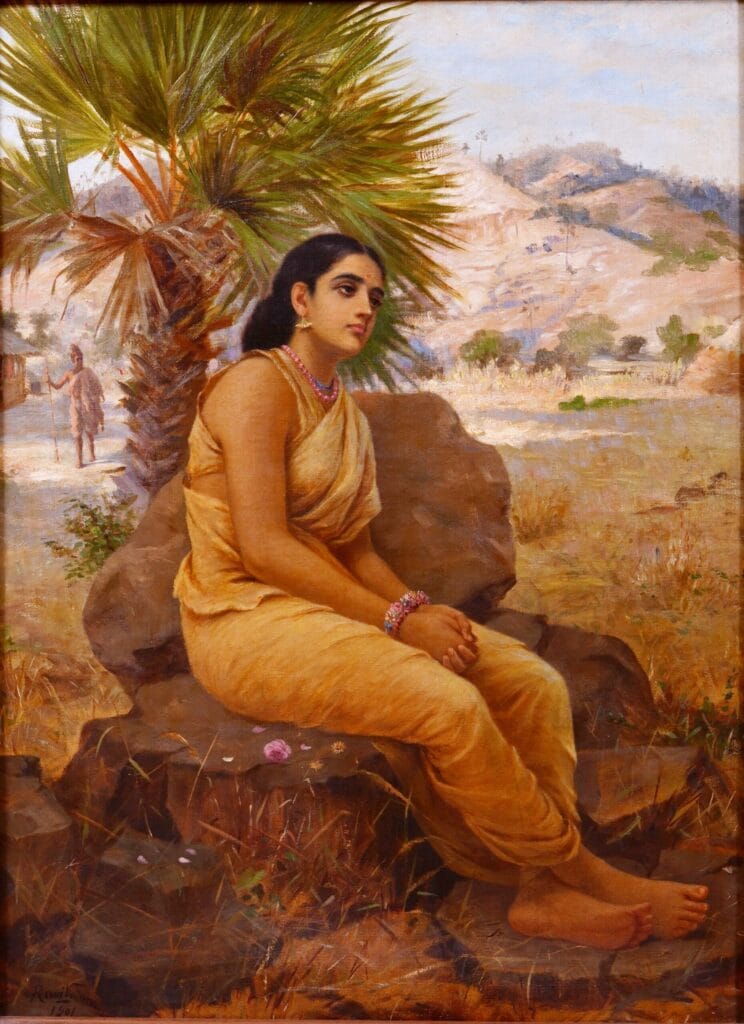
The first chromolithograph off the press, in July 1894, was The Birth of Shakuntala. Shakuntala was already his subject — the heroine of Kalidasa’s play appears across his painted work, and two of those compositions are in our catalogue: Sakuntala Patralekhan, where she writes a love letter on a lotus leaf, and Shakuntala Lost in Thought.
What the prints actually did
Varma’s paintings fused European academic oil technique with Indian subjects. That combination is what made them reproducible: they had the tonal depth and modelled realism that chromolithography could carry, and the subjects that a subcontinent already knew by heart.
The consequence was not artistic, it was social. Before the press, a painted image of Lakshmi or Saraswati was a commissioned object, owned by those who could pay a painter. Afterwards it was a print, sold by picture merchants from Punjab to Travancore, hung in ordinary homes. For the first time, people separated by hundreds of miles were looking at the same picture of the same god.
This mattered more than it sounds. Temple access in Travancore was restricted by caste and gender, and remained so for decades — the Temple Entry Proclamation came only in 1936. A print required no permission from anyone. It went into the house.
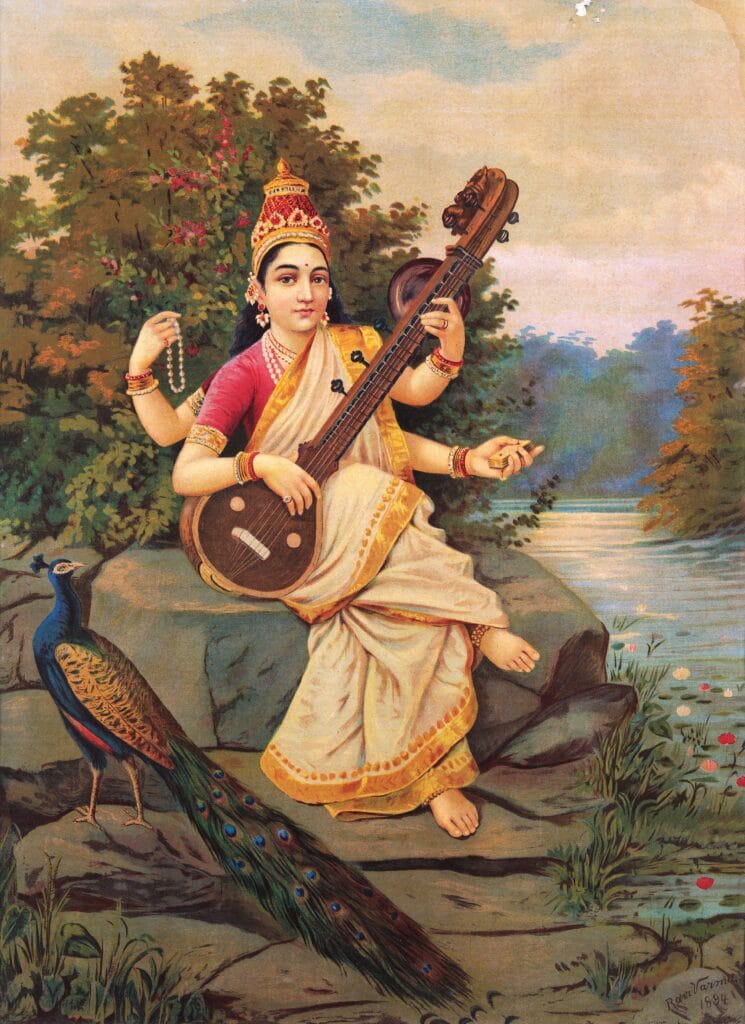
If you want to see how far that reach went: the goddess in that image is close to the version most Indians still picture. Saraswati is in the catalogue, as is Radha in the Moonlight.
The press failed
Plague broke out in Bombay in the 1890s and the press was moved to Ghatkopar; Makhanji left the partnership soon after. Labour was short. Rival presses copied the images freely. The Varma brothers had painting commissions to fulfil and could not manage the business. It moved again, to Malavali near Lonavala, and kept losing money.
Around 1901 Varma sold the controlling interest to Fritz Schleicher — the German technician he had hired to set the machines up — along with the reproduction rights to over a hundred of his paintings. Schleicher renamed it, ran it well, and expanded into postcards, advertisements, calendars, textile labels and matchbox labels. It outlived both Varma and Schleicher, burned down in 1972, and was finally wound up in the 1970s.
One footnote worth keeping: among the artists who worked at that press was Dadasaheb Phalke, who went on to make the first Indian feature film. The place that industrialised the Indian image also trained the man who set it moving.
Why this sits oddly with us
Varma was criticised in his own time for cheapening high art, for borrowing European technique, for turning gods into merchandise. Some of that criticism has never quite gone away.
We are, plainly, in the same business. ISKUSS exists to reproduce paintings so that people who will never stand in the Rijksmuseum or own an original can live with the image. That is the argument Varma lost with the critics and won with everyone else.
The difference between a good reproduction and a bad one was his problem too. He imported German machinery rather than settle for what was available, and hired the technicians who knew how to use it, because a badly printed goddess was worse than none.
Ravi Varma in the catalogue
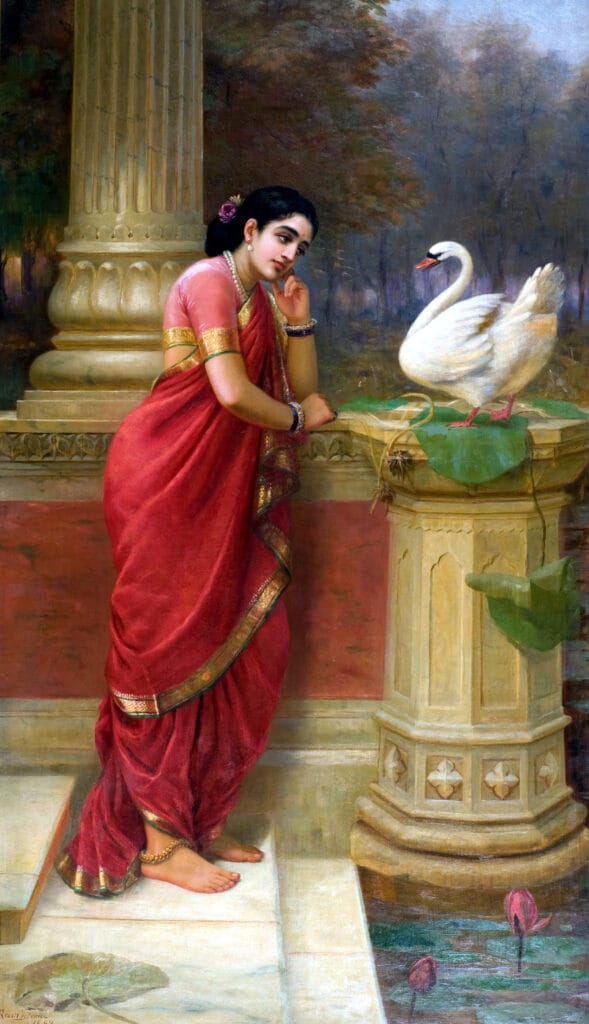
We stock these works by Ravi Varma: Sakuntala Patralekhan, Ahalya leaning on a tree, Damayanti and the Swan, Kadambari, Radha in the Moonlight, Reverie, Saraswati, Shakuntala Lost in Thought and Vasantika.
Most sit in Myth & Devotion alongside Botticelli, Bosch and Rembrandt, which is roughly where Varma would have wanted them — not in a separate room marked Indian, but on the same wall as everyone else.