
Caravaggio painted some of the most devout pictures in Rome while being, by almost any measure, one of its most dangerous residents. The police records survive alongside the altarpieces. He was arrested for carrying a sword without a licence, for throwing a plate of artichokes at a waiter, for insulting the city guard, for assault. In 1606 he killed a man, fled the city with a death sentence on his head, and spent the last four years of his life on the run.
The paintings from those years are among the most moving religious images ever made. That is the uncomfortable fact at the centre of his story, and it is why people keep coming back to him.
The boy from Lombardy
He was born Michelangelo Merisi in 1571 and took his working name from the small town of Caravaggio near Milan, where his family came from. His father died of plague when he was five. He trained in Milan, then arrived in Rome in his early twenties with no money and no reputation, working in other painters’ studios turning out still lifes and half-length figures by the dozen.
What changed his fortunes was a cardinal. Francesco del Monte bought some of his early pictures, took him into his household and introduced him to the collectors who mattered. Within a few years Caravaggio had his first major public commission, and it made him famous almost overnight.
The picture that made his name
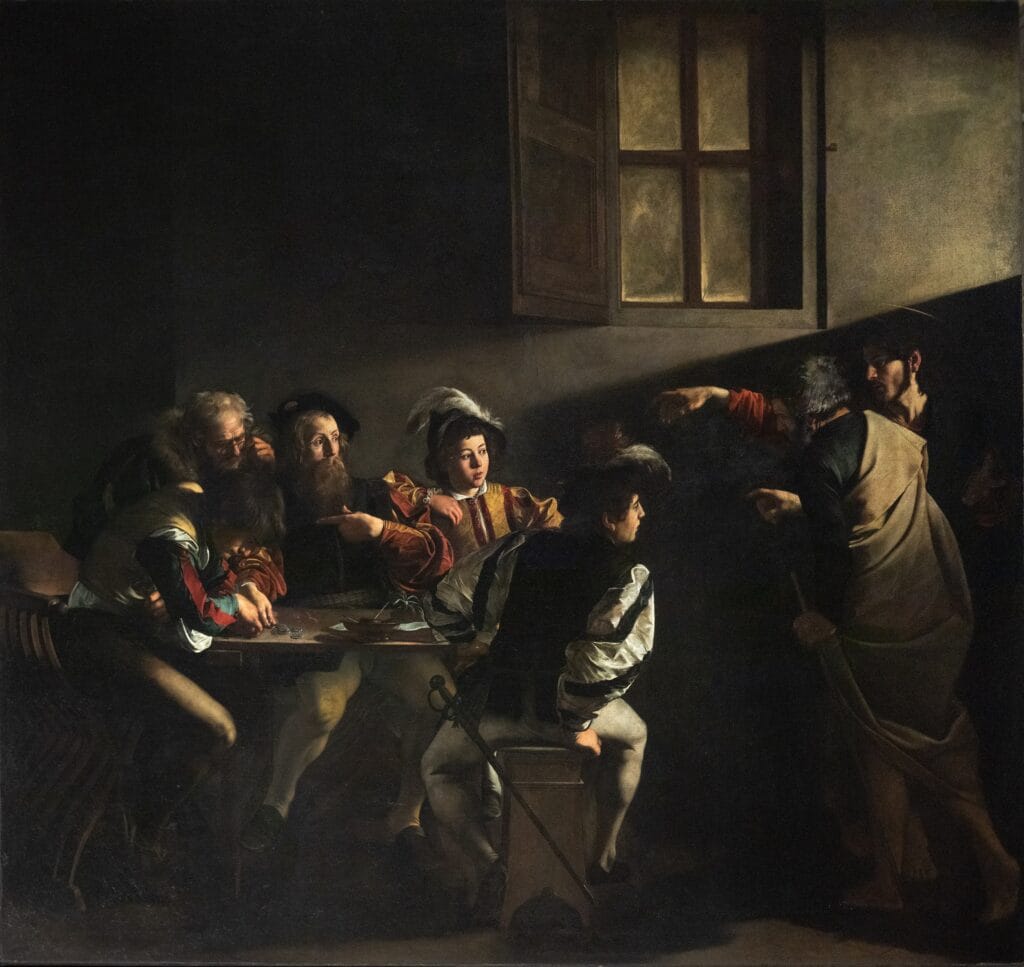
That commission was for the Contarelli Chapel in the church of San Luigi dei Francesi, and its centrepiece is The Calling of Saint Matthew. Christ enters a dark room on the right. A group of men sit around a table counting money. A beam of light cuts across the wall above them, and Matthew, the tax collector, points at himself as if to ask whether he can possibly be the one being called.
Nobody in Rome had painted a sacred scene like this. The apostles are not idealised figures on clouds; they are men in contemporary clothes in what looks like a tavern. The light does the storytelling. Viewers queued to see it, rival painters complained it was vulgar, and commissions followed.
The technique has a name now — tenebrism, from the Italian for darkness — but at the time it simply looked like nothing else. Figures emerge from near-black backgrounds as if lit by a single high window. It is theatrical, and it is also very practical: by throwing most of the canvas into shadow, Caravaggio could put all his effort into the parts he wanted you to look at.
Saints with dirty feet
The thing that most upset his patrons was his models. He painted from life, using people he found in the streets around him, and he did not clean them up. In The Conversion of Saint Paul, the saint lies on his back under a horse whose rump fills half the picture; a groom looks on as though nothing unusual is happening. In The Crucifixion of Saint Peter, three labourers strain to lift the cross, and one of them pushes his backside straight towards the viewer.
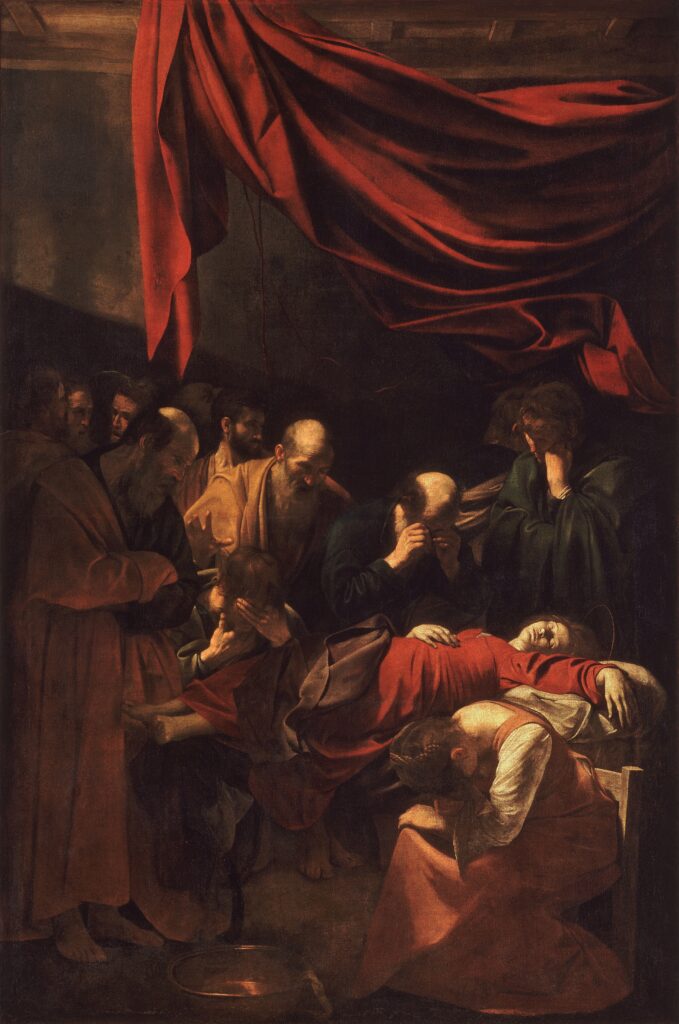
The Death of the Virgin went further. The Virgin lies on a bed with her feet bare and her body swollen, and the church that commissioned it rejected it outright. Stories circulated that he had used a drowned woman from the Tiber, or a known courtesan, as his model. Whatever the truth, the painting was bought instead by the Duke of Mantua on the advice of a young Flemish painter called Rubens, and it now hangs in the Louvre.
The same instinct produced Judith Beheading Holofernes, where the heroine recoils even as she cuts, and her old servant waits with the bag. Caravaggio does not make the act noble or clean. He makes it difficult, which is exactly why it is believable.
A temper the police knew well
Through all of this he was constantly in trouble. The Roman court records list arrest after arrest — for carrying weapons, for brawls, for throwing stones, for writing insulting verses about a rival painter. Powerful patrons kept getting him out.
In May 1606 that stopped working. During a fight connected to a game of tennis, he killed a man named Ranuccio Tomassoni. Caravaggio was wounded himself and fled Rome. The pope’s court declared a sentence that allowed anyone who found him to kill him.
Four years on the run
What follows reads like an adventure story, and it produced some of his greatest work. He went first to Naples, where he was still famous enough to win major commissions. Then to Malta, where he painted for the Knights of Saint John and was made a knight himself — until he was involved in another violent quarrel, imprisoned, escaped over the walls and was expelled from the order.
He crossed to Sicily, moving between Syracuse, Messina and Palermo, painting large altarpieces in each place and, by contemporary accounts, sleeping armed. Back in Naples in 1609 he was attacked outside a tavern and badly disfigured. The late pictures get darker, emptier and more still. Figures are smaller in larger spaces. The violence of the early work turns into something closer to grief.
The Entombment of Christ, painted before the flight, already points in that direction — a group of mourners lowering a heavy, unmistakably dead body towards a stone slab that juts out at the viewer, as if the burial were happening at the edge of the room.
The last journey
In 1610 his friends in Rome were negotiating a papal pardon. Caravaggio set out by boat from Naples towards Rome with a few paintings he intended as gifts for the people arranging it. Somewhere along the coast at Porto Ercole he was detained, separated from his boat and its cargo, and died of a fever in July. He was thirty-eight.
The pardon, according to most accounts, was already on its way.
Why he matters more now than then
For about two hundred years after his death, Caravaggio was out of fashion. His followers — the so-called Caravaggisti across Italy, Spain and the Netherlands — had spread his lighting so widely that it became a cliché, and critics treated him as a talented brute. It took twentieth-century scholarship, and a major exhibition in Milan in 1951, to restore him as one of the central figures in European painting.
What strikes people now is how modern he feels. The cropping, the close-up figures, the sense that the viewer is standing in the room — these read almost like film stills. Rembrandt, Velázquez and Georges de La Tour all learned from him, and through them most of the painters who followed.
Living with a Caravaggio
These are not quiet pictures, and that is worth knowing before you hang one. Their darkness is a large part of their effect: a Caravaggio on a pale wall reads as a lit window into another room.
The Calling of Saint Matthew at 44 by 42 inches is almost square and works on most walls. The Conversion of Saint Paul and The Crucifixion of Saint Peter are both 34 by 44, upright, and make a strong pair. The Death of the Virgin and The Entombment of Christ are the large ones at 36 by 54 inches and want a tall wall with some space around them.
They are happiest in warm, low light and on deep wall colours — charcoal, dark green, oxblood — which make the black backgrounds disappear into the wall. All of them are in Myth & Devotion.
It is strange to think that the most convincing images of saints in Western art were made by a man the authorities wanted dead. Caravaggio painted holiness the only way he knew how — by painting the people he actually saw.