
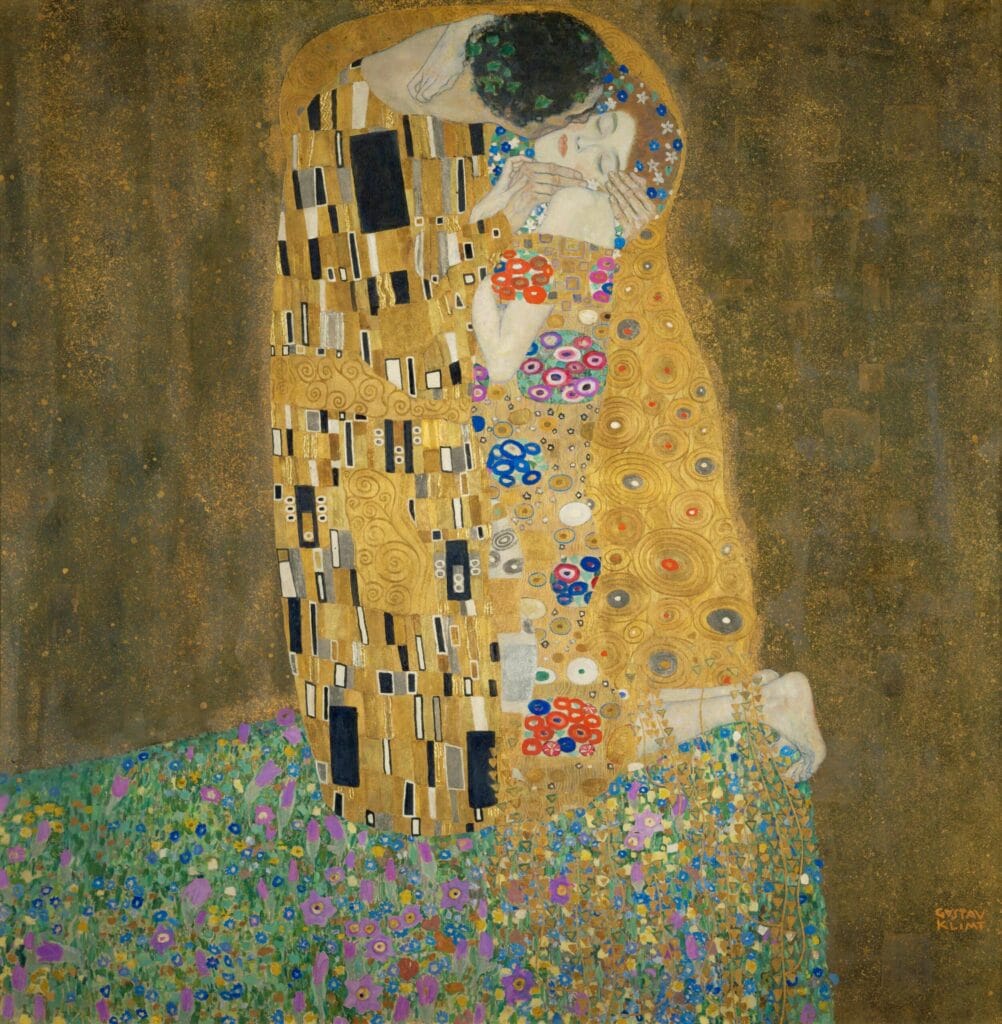
The gold in The Kiss is real gold leaf. Not gold-coloured paint, not metallic pigment — actual metal, beaten to a fraction of the thickness of a hair, laid onto the canvas and burnished. In places it is silver and platinum leaf too, which is why the man’s robe carries cool greys alongside the warm yellows.
This is worth saying plainly on a page that sells a printed reproduction, because it is the one thing a print cannot do.
Where the gold came from
Klimt’s father was a gold engraver, so he grew up around the material. But the decision to use it came from a trip to Ravenna in 1903, where he saw the Byzantine mosaics at San Vitale.
What struck him was that the gold ground in those mosaics abolishes space. There is no depth behind the figures, no landscape, no horizon — just a flat metal plane that throws the figures forward. He spent roughly the next six years doing that to portraits.
What a reproduction can and cannot carry
A photograph fixes metal at one brightness. Standing in front of the canvas at the Belvedere, the gold changes as you move — it is closer to goldsmith’s work containing a painting than a painting that happens to be gold.
A print cannot do that, and anyone telling you otherwise is selling something. What a good reproduction does carry is the composition, the pattern, the colour relationships and the scale — which is most of why the image works, but not all of it.
We would rather say that than pretend. It is the same reason we describe Water Serpents II as a printed canvas and not as gilded.
How thin is gold leaf
Roughly a tenth of a micrometre. A sheet will tear in a draught, and it cannot be picked up with fingers — gilders lift it with a flat brush charged with static.
It is laid onto a prepared surface made tacky with size, then burnished down and worked over. Klimt tooled patterns directly into the metal so that different areas catch light at different angles. The spirals and rectangles in the lovers’ robes are not painted on top of gold; many of them are worked into it.
He used silver and platinum leaf alongside the gold. The cool greys in the man’s robe are not grey paint standing in for metal. They are a different metal.
Six years, then he stopped
The golden phase runs roughly from 1901 to 1909. Before it he was a successful, fairly conventional decorative painter doing ceilings for public buildings in Vienna. After it he moved on to dense patterned colour without the metal.
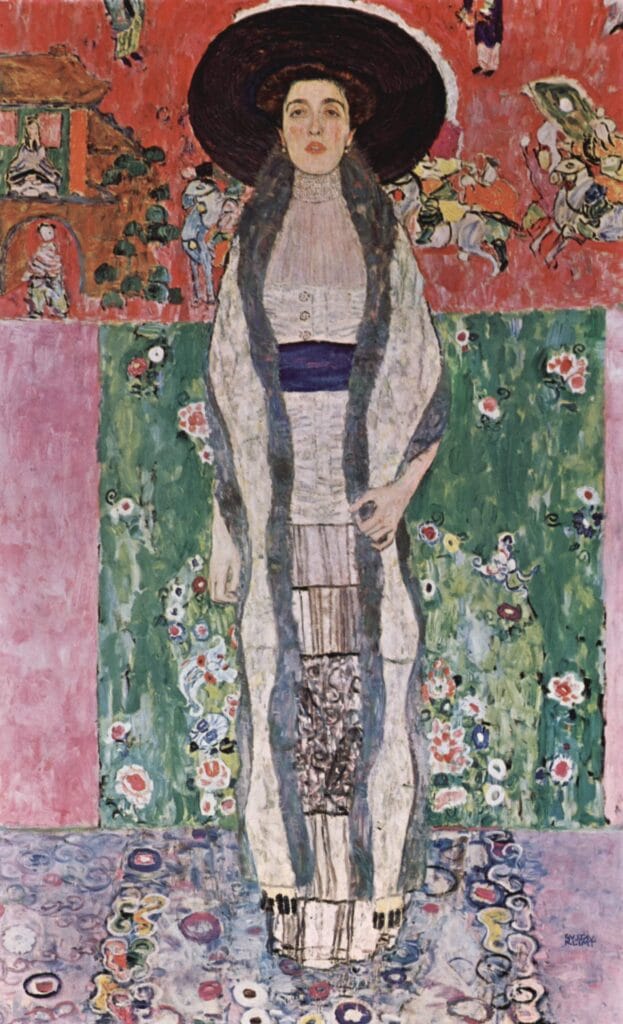
Portrait of Adele Bloch-Bauer II belongs to that later moment — same instinct for pattern, no gold. It is a useful thing to see beside The Kiss, because it shows how much of the effect was the composition rather than the material.
What a print does carry
Being honest about the limitation is not the same as saying a reproduction is pointless. What survives reproduction is most of why the image works.
The composition survives — two figures fused into a single golden shape, the man’s head pushed almost to the top edge in a way that borrows from Japanese prints. The pattern survives: rectangles on his robe, circles and ovals on hers, a distinction that carries the whole meaning of the picture.
The colour relationships survive. The scale survives, which matters more than people expect, because the original is a very large square and the composition was built for that shape.
What does not survive is the shift as you move, and the fact that the surface is metal rather than image. If you ever get to Vienna, that is the thing to go and look at.
Which Klimt for which room
The Kiss is square at 36 by 36 inches, which is unusually forgiving — square works sit well on walls that are neither obviously wide nor obviously tall.
Water Serpents II is 54 by 30, a long horizontal. It is the one for above a sofa or a long sideboard, and it is difficult to place anywhere else.
Portrait of Adele Bloch-Bauer II is the smallest at 18 by 30 inches — the right scale for a narrow wall, a hallway, or as part of a group.
All three are in Abstract & Modern.
Living with a gold picture
Gold-heavy images are demanding neighbours. They pull warmth out of everything near them, and a wall colour that looked neutral can turn slightly green once a Klimt is on it.
They sit best on warm off-whites, deep greens and charcoal. They fight with cool greys and with anything blue-based.
They also want lower, warmer light than most work — the same reason the Belvedere lights The Kiss carefully. Under cool overhead LEDs the golds go flat and slightly brassy. A warm bulb, or daylight from the side, is considerably kinder.
Why this one image is everywhere
The Kiss is among the most reproduced images of the twentieth century, on more mugs and phone cases than almost anything else. That ubiquity has a cost: it is easy to stop seeing it.
It is worth remembering that it was bought unfinished by the Austrian state straight from the exhibition where it was first shown, and that it has never been sold since. It survived the war because it had been moved out of Vienna for safekeeping — several other Klimts did not.
The painting on your wall is a reproduction of an object that very nearly did not make it.