
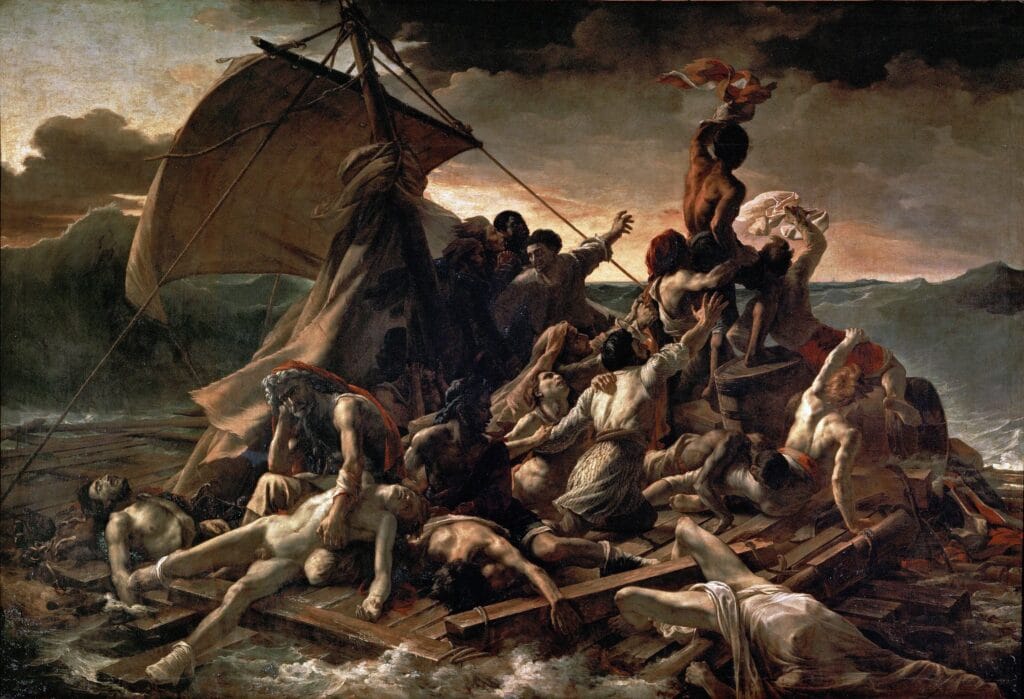
In the summer of 1818, a twenty-seven-year-old painter named Théodore Géricault shaved his head, shut himself in a studio near a Paris hospital, and filled the room with pieces of human bodies. Severed heads and limbs from the morgue lay on the floor so that he could study how flesh changes as it dies. Visitors could barely stand the smell.
The painting he was making, The Raft of the Medusa, is now one of the most famous pictures in the Louvre. The story behind it was, in its day, a national scandal.
A frigate, a sandbank and a captain who should not have been there
In June 1816 the French navy frigate Méduse sailed for Senegal, carrying soldiers, officials and settlers to take back a colony from the British. In command was Hugues Duroy de Chaumareys, an aristocrat who had spent the Revolution in exile and had barely been to sea in twenty years. He owed his appointment to the restored monarchy, not to his seamanship.
On 2 July, having pulled far ahead of the rest of the convoy, the Méduse ran aground on a well-known sandbank off the coast of what is now Mauritania. There were not enough lifeboats. About a hundred and fifty people — mostly soldiers and sailors — were put onto a hastily built raft, which was supposed to be towed by the boats carrying the captain and the senior passengers. Within a short time the tow lines were cut, and the raft was left drifting.
Thirteen days
What happened on the raft over the next thirteen days became the scandal. There was almost no food and only casks of wine. On the first night men were washed off or crushed. Mutinies broke out, and the strongest threw the weakest into the sea. Starving survivors resorted to eating the dead.
When the ship Argus came across the raft by chance on 17 July, fifteen men were still alive. Several died soon after. Two of the survivors, the ship’s surgeon Henri Savigny and the engineer Alexandre Corréard, published an account in 1817. It became a sensation, and it was explosive politically: here was an incompetent royalist captain, appointed for his loyalty, who had abandoned his men. The government did its best to keep the story quiet. Géricault chose to put it on a canvas more than seven metres wide.
Who was Géricault
He was an odd figure to take on a subject like this. Born in Rouen in 1791 to a wealthy family, he never needed to sell a painting. He was obsessed with horses — he rode hard and painted them constantly — and he had already made a name at the Salon with a heroic cavalry officer on a rearing horse.
But by 1818 he was restless. He had spent a year in Italy studying Michelangelo, had a complicated and secret love affair behind him, and wanted to make a single great picture that would establish him. He found his subject in the Savigny and Corréard account.
Research like a journalist
What sets the painting apart is how seriously he researched it. Géricault interviewed Savigny and Corréard at length. He found the carpenter from the Méduse, who had survived the raft, and had him build a scale model of it in the studio. He studied patients in the hospital, the dying and the dead.
He also worked through the possible moments to paint — the mutiny, the cannibalism, the rescue — and rejected them one by one. In the end he chose the instant the survivors first see the Argus on the horizon, so small it is almost invisible, and do not yet know whether it has seen them.
The composition is built as two pyramids. One rises from the dead and dying at the bottom left up to the man waving a cloth at the top right, a surge of hope towards the distant ship. The other is the mast and the sail, leaning back the other way, with the wind pushing the raft away from rescue. The picture holds both possibilities at once. Among the figures, the young Eugène Delacroix posed for one of the bodies in the foreground.
The Salon of 1819
It went on show at the Salon in 1819 under the cautious title Scene of a Shipwreck. Nobody was fooled. Supporters of the government saw it as an attack; opponents saw it as a political statement. Some critics found it horrifying, some magnificent. The state did not buy it.
Géricault took it to London instead, where it was shown in 1820 and drew enormous crowds — tens of thousands of paying visitors. It was one of the first blockbuster exhibitions, and it made him real money for the first time.
Thirty-two years
He did not live to enjoy it. After a series of riding accidents and a long illness, Géricault died in January 1824 at the age of thirty-two. The Louvre acquired The Raft of the Medusa shortly afterwards, and it has hung there since.
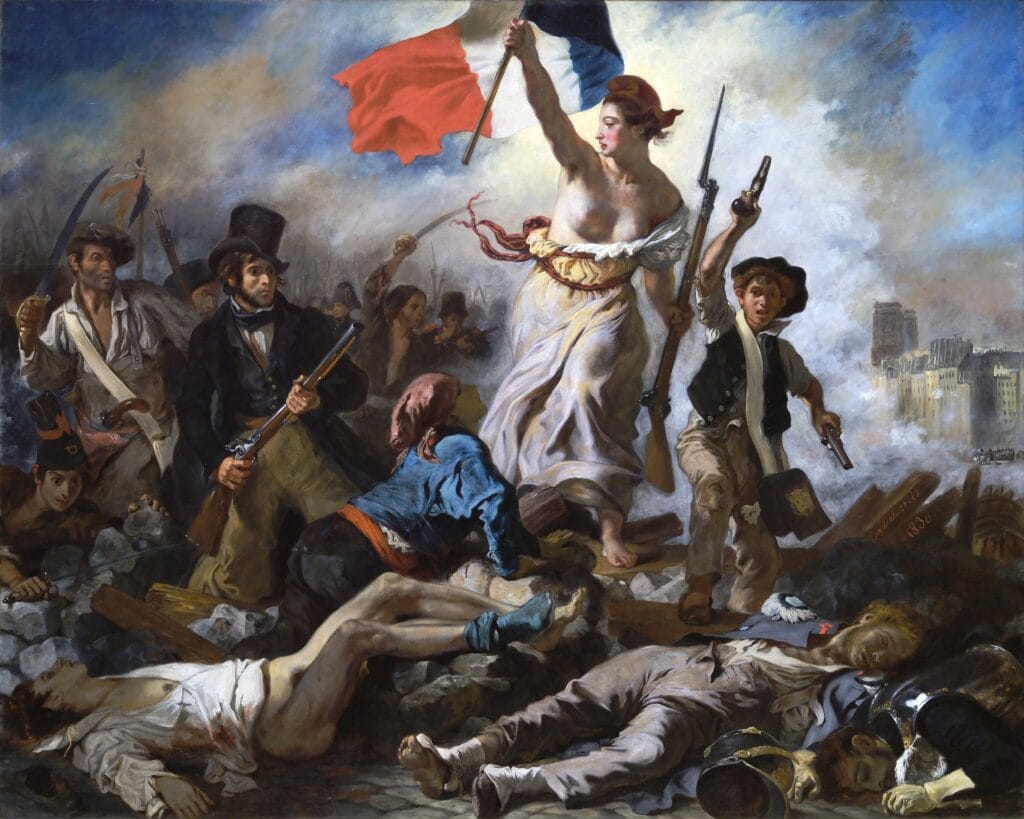
His influence was out of all proportion to his short career. The painting is generally treated as the opening of French Romanticism — the move away from calm, idealised classical subjects towards contemporary events, raw emotion and suffering bodies. Delacroix, who had posed for it, carried that forward in The Massacre at Chios and Liberty Leading the People. Goya’s The Third of May 1808, painted in Spain a few years before, shares the same refusal to make violence noble.
A painting that is slowly going dark
There is a sad postscript. Géricault used bitumen, a tar-like brown pigment fashionable at the time because it gave rich, deep shadows. Bitumen never fully dries. Over two centuries it has darkened and cracked across much of the canvas, and some passages of the original are now hard to read even standing in front of it in the gallery.
Living with the Raft
This is not a gentle picture, and it is worth thinking about where it goes. It is dramatic, dark and full of movement; it works best where it can be seen from a distance and does not have to compete with patterned walls or busy shelving.
The Raft of the Medusa is 52 by 36 inches, a strong horizontal. It suits a study, a hallway with depth, or a living room with a deep wall colour — navy, slate or dark olive bring out the stormy greens. It sits in Life & Places beside the other great history paintings of the period.
Every time you pass it, there is that tiny ship on the horizon. That was the point.