
Monet kept painting the same things. Not because he ran out of ideas, but because repetition was the idea. Once you know that, choosing one of his paintings becomes a different exercise.
The subject was never the subject
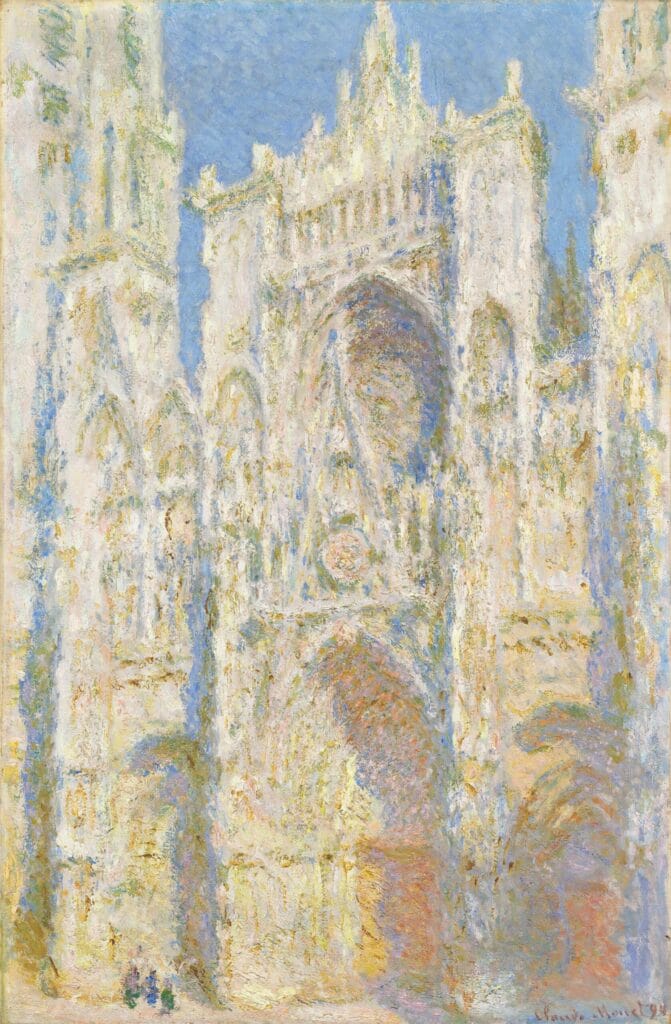
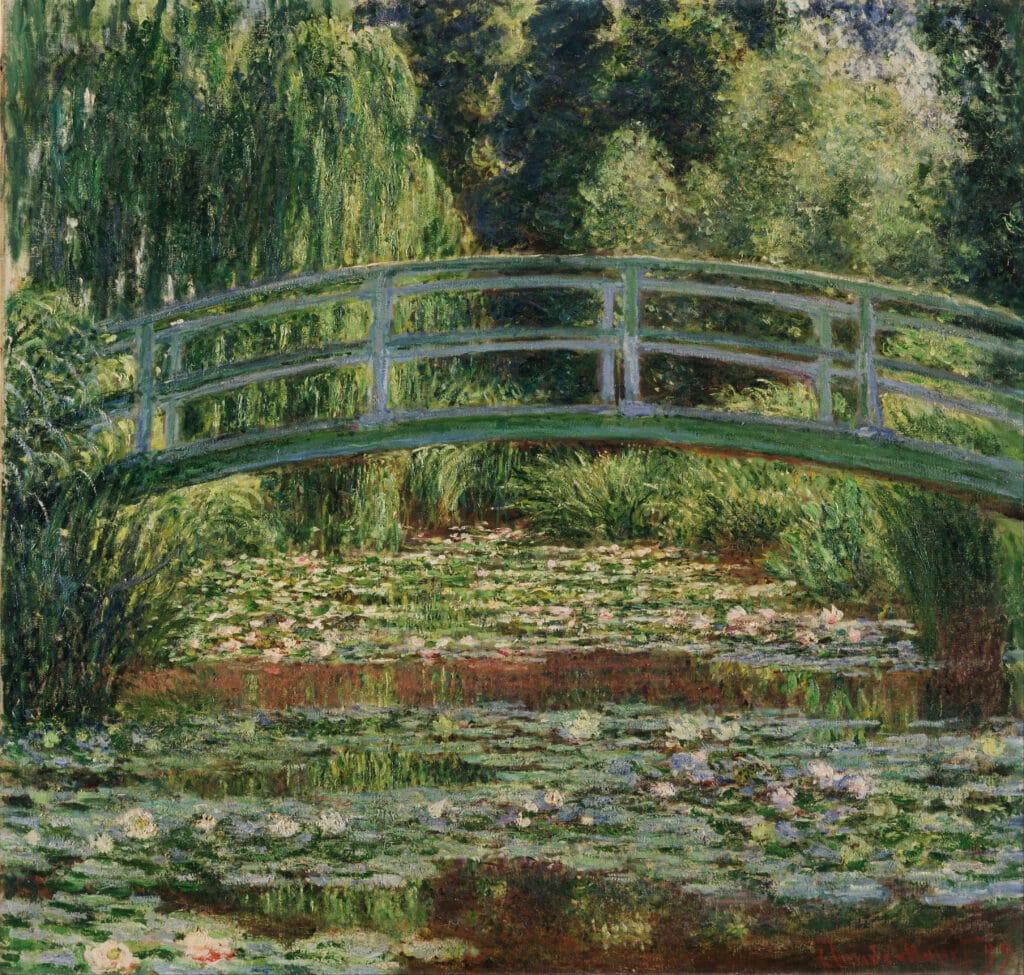
He painted grainstacks in a field through the seasons. He painted the west front of Rouen Cathedral over and over from a room across the street. He painted the footbridge in his own garden, and then the water beneath it for the rest of his life.
The stacks and the stone were not what interested him. What interested him was that they looked completely different at eight in the morning and four in the afternoon, in August and in February. He was painting the light, and he needed something that held still so the light could be seen changing against it.
This is why the paintings come in groups. A single canvas from a series is a reading of one moment. It is a measurement.
Working against the clock
Painting light rather than objects creates a practical problem: the light will not wait. Monet dealt with it by working on several canvases at once, moving from one to the next as the hour changed and the conditions on each canvas came round again.
At Rouen he rented a room across from the cathedral and worked from the window, swapping canvases through the day. He complained constantly in letters about how hard it was — not the painting, the weather. A cloud crossing the sun made the canvas he was working on temporarily wrong.
It is an oddly modern way to work. Each canvas is a data point. The meaning is in the set.
Why the cathedral series is the strangest one
Grainstacks and water lilies are pleasant subjects. A gothic facade is not obviously one — it is grey, vertical, architectural and static, and it fills the entire canvas with almost no sky and no ground.
That is precisely why he chose it. There is nothing to look at except the surface and what the light is doing to it. The stone dissolves into colour; at some hours the facade is blue, at others almost orange.
On a wall this behaves differently from the rest of his work. It is closer to abstraction than anything else we stock by him, and it rewards a room where you will actually stand in front of it rather than glance across at it.
The late work and the eyes
The water lily paintings run to the end of his life, and in the later years his sight was failing with cataracts. Colours shifted for him; some of the late canvases are markedly redder and looser than what came before.
It is tempting to read that as tragedy, or as accidental modernism. The more careful position is that he knew, had surgery eventually, and kept working through it deliberately. The late canvases are not mistakes.
What that means for your wall
It means the light in the painting will decide how it behaves in your room.
Haystacks, End of Summer is a late-summer picture, warm and low. It will sit well in a room that gets afternoon sun and will look correct under warm bulbs in the evening.
Rouen Cathedral, West Facade is the cooler proposition — stone and grey light, portrait format at 30 by 46 inches, and it wants a wall with height rather than width.
The garden pictures
The Japanese Footbridge and Water Lilies are the same body of work at different distances. The bridge gives you a structure to hold on to — a horizon, an object, a place to stand. The water lilies take that away. There is no horizon and no edge to the pond; you are looking straight down into water.
People find the lilies calmer and the bridge easier. Both are true. If a room needs something to settle into, the bridge. If it needs something to dissolve into, the lilies.
Reading the light before you buy
Since the light in the painting is the subject, match it to the light in the room. This is more useful advice than matching colours to a cushion.
A room with morning light and cool north-facing walls will make a warm late-summer canvas look warmer still, which is usually pleasant. The same canvas in a room already flooded with warm afternoon sun can tip into orange.
Cooler works — the cathedral, the deeper water lilies — hold their character under almost any light, which makes them the safer choice if you do not know the room well yet.
Scale, since these are all large
The four we stock run from 30 by 46 inches to 51 by 48 inches. None of them are small works, and that is faithful to the originals rather than a commercial decision.
The Japanese footbridge at 51 by 48 is very nearly square. Square works are the most forgiving shape you can hang — they suit walls that are neither clearly wide nor clearly tall, and they do not demand a partner. If you have one awkward wall and no idea what to put on it, a square canvas is the reliable answer.
Buying more than one
Series paintings are among the few works that genuinely improve in pairs, because that is how they were conceived. Two Monets from different series will fight. Two readings of the same light will not.
All four sit in Landscape & Seascape and Life & Places.