
The most common mistake in buying art for a wall is not taste. It is scale. People buy something too small, hang it too high, and the room looks like it is apologising.
Here is what the numbers actually mean in a room.
What the inches look like
Every canvas we sell is a single fixed size, scaled to the proportions of the original painting. The longest side runs from 24 inches at the smallest to 54 inches at the largest.
24 to 30 inches. Reads as a picture. Fine above a desk, in a hallway, beside a door, or in a group of several. On a large empty wall it will look lost.
36 to 44 inches. The workhorse range. Holds its own above a console table, a bed, or a two-seat sofa. This is where most of the catalogue sits.
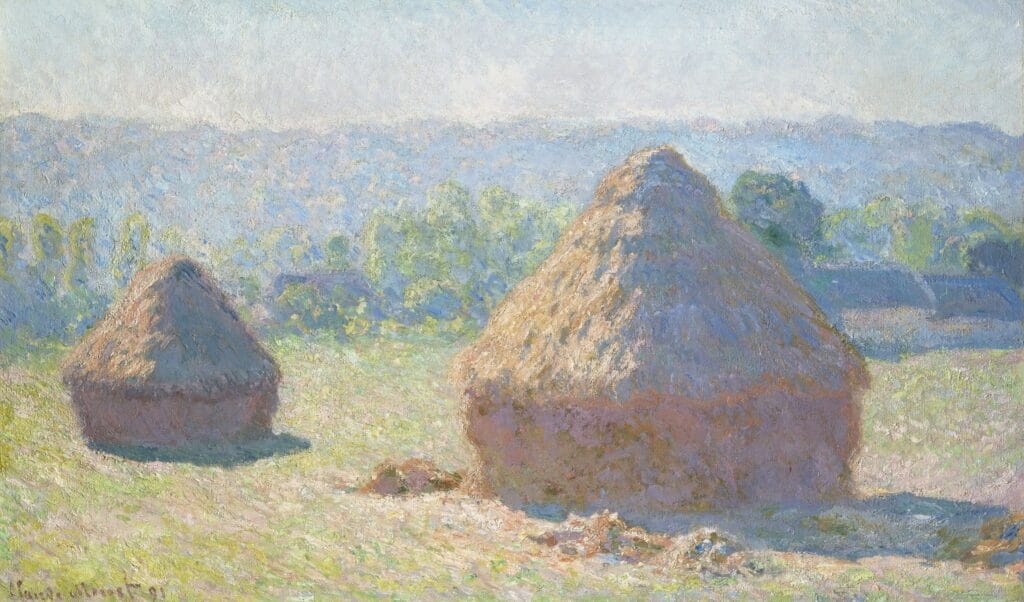
46 to 54 inches. Furniture-scale. It becomes the thing the room is arranged around. Haystacks, End of Summer at 54 inches and Water Serpents II at 54 inches both work this way.
The rule that actually helps
Art above furniture should be roughly two-thirds the width of the furniture beneath it. A 72-inch sofa wants something around 48 inches. A 60-inch sideboard wants around 40.
That single ratio prevents most bad hangs. If you take nothing else from this, take that.
The second rule is height: the centre of the picture at about 57 to 60 inches from the floor, which is average eye level. Most people hang too high. If you have ever seen a picture that seems to be floating away from the sofa, that is why.
Why people buy too small
Almost always for the same two reasons. On a screen, a canvas is shown filling the frame, so 24 inches and 54 inches look identical while you are choosing. And a larger picture feels like a bigger commitment, so the cautious choice feels like the safe one.
It is not the safe one. A picture that is too small for its wall does not read as restrained; it reads as an accident. A picture that is slightly too large reads as deliberate. If you are genuinely torn between two sizes, the larger one is almost always right.
Height, and the mistake nearly everyone makes
Hang the centre of the picture at 57 to 60 inches from the floor. That is average standing eye level, and it is the convention galleries use.
Most people hang considerably higher than this, usually because they are aligning to the top of a door frame or to their own eye level while standing close to the wall. The result is art that floats — disconnected from the furniture beneath it, looking up at the ceiling rather than at the room.
Above furniture there is a second rule: leave six to twelve inches between the top of the sofa or sideboard and the bottom of the frame. Closer than six and it looks cramped; further than twelve and the two objects stop belonging to each other.
Groups and pairs
Several smaller works hung as a group behave like one large work, which is a useful way to fill a big wall without a single enormous canvas.
The rule is to treat the whole arrangement as a rectangle and apply the same two-thirds ratio to that rectangle. Keep the gaps consistent — two to three inches for small works, four to six for larger ones — and align either the tops or the horizontal centres, not both.
Mixing portrait and landscape formats in one group is possible but harder. If you are doing it for the first time, keep every piece the same orientation.
Portrait and landscape are not interchangeable
A landscape-format canvas needs width. Above a sofa, over a bed, along a hallway — these are wide spaces and they want wide pictures.
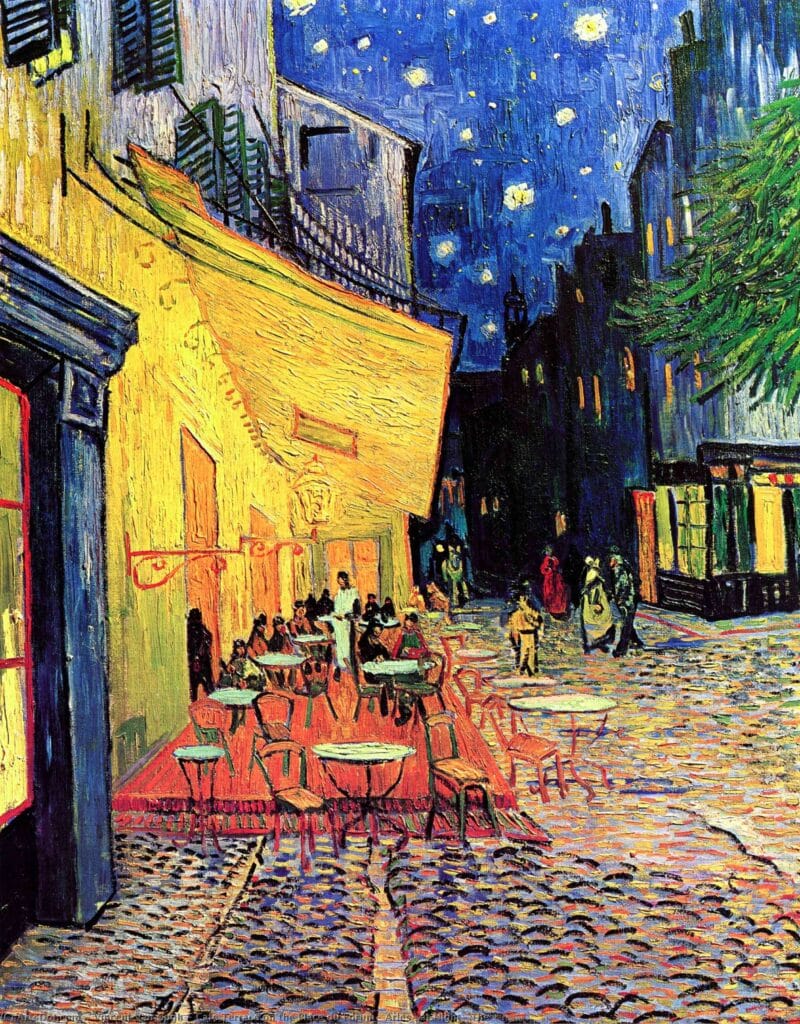
A portrait-format canvas like Cafe Terrace at Night at 42 by 54 inches needs height. Beside a door, in a stairwell, on a narrow pier of wall between windows. Hung above a wide sofa it will look like a stamp on an envelope.
Two-thirds of our catalogue is landscape or near-square, which is worth knowing if the wall you are buying for is tall and narrow.
Rooms that need particular sizes
Above a bed. Match roughly two-thirds of the bed width. A king needs something close to 48 inches; a double is happier around 40. Landscape format, and hang it lower than feels natural — people see it while lying down as well as standing.
A hallway. You pass at speed and at close range, so detail is wasted and scale is everything. One large work at the far end beats several small ones along the length.
A stairwell. The one place portrait format genuinely wins, because the wall is tall and you see it from below. Hang to the centre of the wall, not to the stairs.
Above a desk or in an alcove. The honest home for 24 to 30 inches. Close viewing, small wall, no competition.
One thing worth saying about price and size
Our prices run from US$378 to US$852, and the difference is mostly size rather than which painting it is. A large canvas costs more because it uses more material and more ink, not because the image is more valuable.
Which means the cheapest way to get a work you love onto a wall is not to buy a smaller version of it. It is to find the work whose true proportions suit the wall you actually have.
Measure before you choose
Cut a rectangle of newspaper to the exact dimensions and tape it to the wall for a day. It costs nothing and it settles the argument. Almost everyone who does this ends up going one size larger than they first intended.
Every product page lists the finished dimensions in inches. Browse by what fits in Landscape & Seascape or Portraits & Figures.