
Amrita Sher-Gil painted for about ten years and died at twenty-eight. In that time she was honoured by the Paris Salon, travelled the length of India looking for a subject, found one, and produced a body of work that the Indian government later declared a national art treasure. Her paintings may not leave the country.
Her life is short enough to tell in an afternoon and full enough that people have written whole books about single years of it.
Born in Budapest
She was born in Budapest in 1913. Her father, Umrao Singh Sher-Gil, was a Sikh aristocrat with a passion for Sanskrit and astronomy and photography; her mother, Marie Antoinette Gottesmann, was a Hungarian opera singer. The family moved to Shimla in 1921, and the girl who would become one of India’s defining painters spent her childhood between two very different worlds.
She drew constantly. An uncle, the Indologist Ervin Baktay, looked at her drawings, told her parents she was serious, and encouraged her to paint from life — the servants, the household, the people around her. It was advice she would come back to.
Paris at sixteen
In 1929, at sixteen, she went to Paris to study, first at the Académie de la Grande Chaumière and then at the École des Beaux-Arts. She learned to paint in the European academic manner and learned it fast. Her teachers praised her; the French art world noticed her.
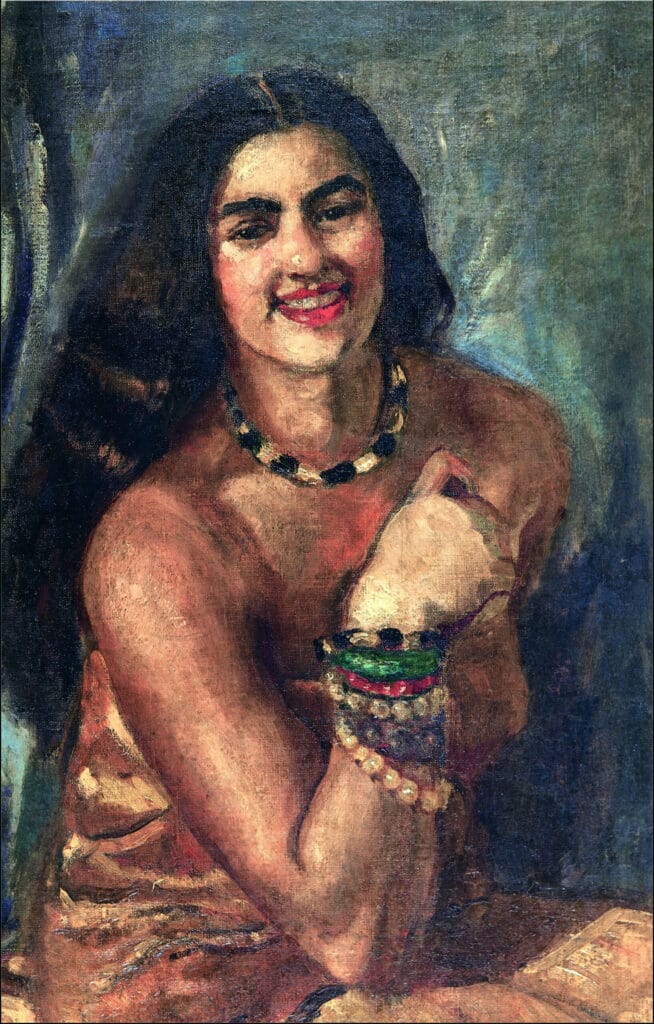
Her Self-Portrait belongs to these years — direct, slightly guarded, painted with the confidence of someone who already knew she was good. In 1933 her painting Young Girls was shown at the Paris Salon, and she was elected an associate of the Grand Salon, a rare distinction for anyone, let alone a twenty-year-old Asian woman.
“Europe belongs to Picasso”
And then she left. She wrote that she had begun to be haunted by an intense longing to return to India, feeling that her destiny as a painter lay there. In a letter she put it more bluntly: Europe belonged to Picasso, Matisse and Braque; India belonged only to her.
She came back at the end of 1934 and did something unusual for an artist of her background. Instead of setting up as a fashionable portrait painter in Bombay or Shimla, she travelled — to the Ajanta caves, to the temples and frescoes of the south, to Kerala and Madurai — looking hard at Indian painting traditions that most art schools of the day ignored.
Three Girls and the new subject
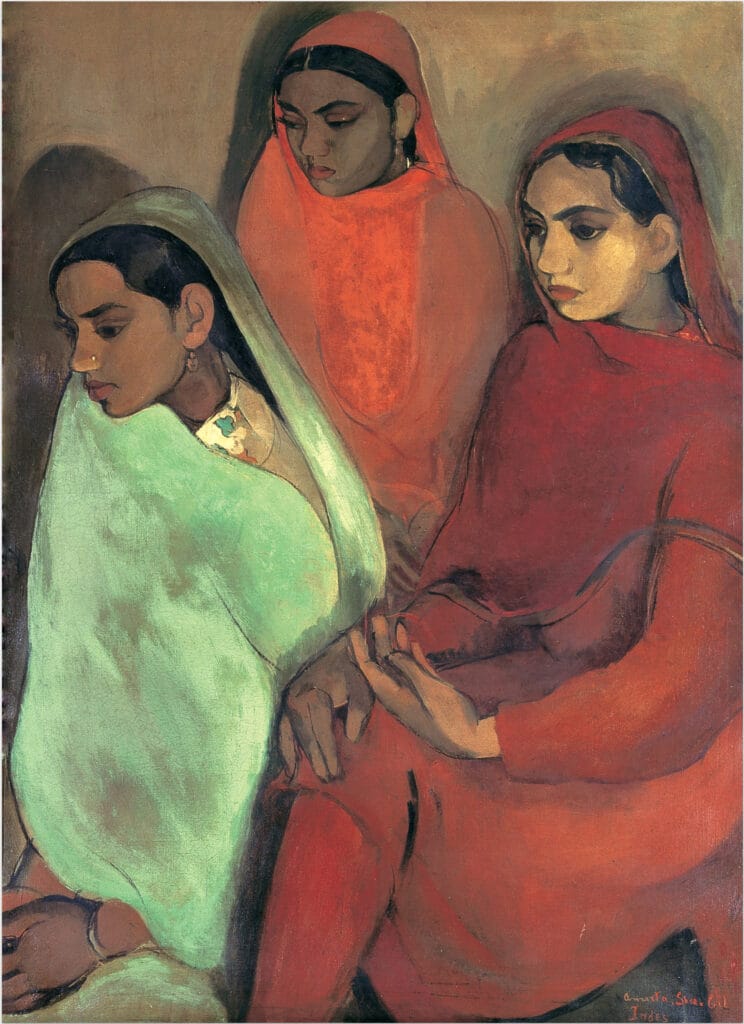
Three Girls, from 1935, is the first painting where you can see the change happening. Three young women sit close together, in red and ochre and green, waiting. Nothing happens in the picture. Their faces are still, a little sad, turned slightly away from each other.
It is a European picture in its composition and its oil technique, and an Indian picture in almost everything else — the colour, the clothing, and above all the subject, which is the inner life of ordinary Indian women. It won the gold medal of the Bombay Art Society in 1937. Sher-Gil had found what she was looking for.
The south and the miniatures
Over the next few years her style kept moving. After the trip south she painted a trilogy of village scenes — Bride’s Toilet, Brahmacharis and South Indian Villagers Going to Market — with flat areas of colour and simplified figures that owe a great deal to Ajanta. The Storyteller, from 1937, belongs to the same moment: women gathered in a courtyard, one of them talking, the others listening, the colours warm and the space shallow.
Later, she discovered the Pahari and Mughal miniature traditions and began working at a smaller scale, with finer detail and a quieter palette, as if she wanted to see how much feeling a very small picture could hold.
Throughout, the subject stays the same. Women resting, working, waiting, gossiping, grieving. She painted rural poverty without turning it into a postcard, and she painted women as people with interior lives rather than as decoration.
Saraya and Lahore
In 1938 she married her Hungarian cousin, Victor Egan, a doctor, and they settled for a time in Saraya in Uttar Pradesh, where her family had estates. The landscape and the people of the sugar-cane country went straight into her work. In 1941 the couple moved to Lahore, then an important art centre, and she prepared for her first major solo exhibition there.
Days before it opened, in December 1941, she fell seriously ill and died. She was twenty-eight. The cause has never been settled — peritonitis and dysentery have both been suggested — and the circumstances have been argued over ever since.
Why she matters
Sher-Gil arrived at a moment when Indian art was split between the academic realism taught in the colonial art schools and the revivalism of the Bengal School, which looked back to older Indian styles. She belonged to neither camp, and she was scathing about both.
What she did instead was to take the most advanced European training available, and the oldest Indian traditions she could find, and put them in the service of one subject. The result is generally treated as the start of modern Indian art, and a whole generation of painters, from the Progressive Artists’ Group onwards, built on it.
In 1976 the Government of India declared her work national art treasures. Most of her paintings are in the National Gallery of Modern Art in New Delhi, and when one of the few in private hands comes to auction, it sets records.
Living with Sher-Gil
Her pictures are quieter than they first appear. The colour is warm and earthy — terracotta, ochre, deep green — and they sit beautifully on white or warm off-white walls, or against natural wood.
Self-Portrait is 28 by 44 inches, upright, and suits a narrow wall or a study. Three Girls at 30 by 40 is the one to build a room around. The Storyteller at 36 by 44 is a little larger and works well in a living or dining room where people gather — which, given the subject, seems right.
Self-Portrait and Three Girls are in Portraits & Figures; The Storyteller is in Life & Places. Ten years of work, and Indian painting was never the same.