
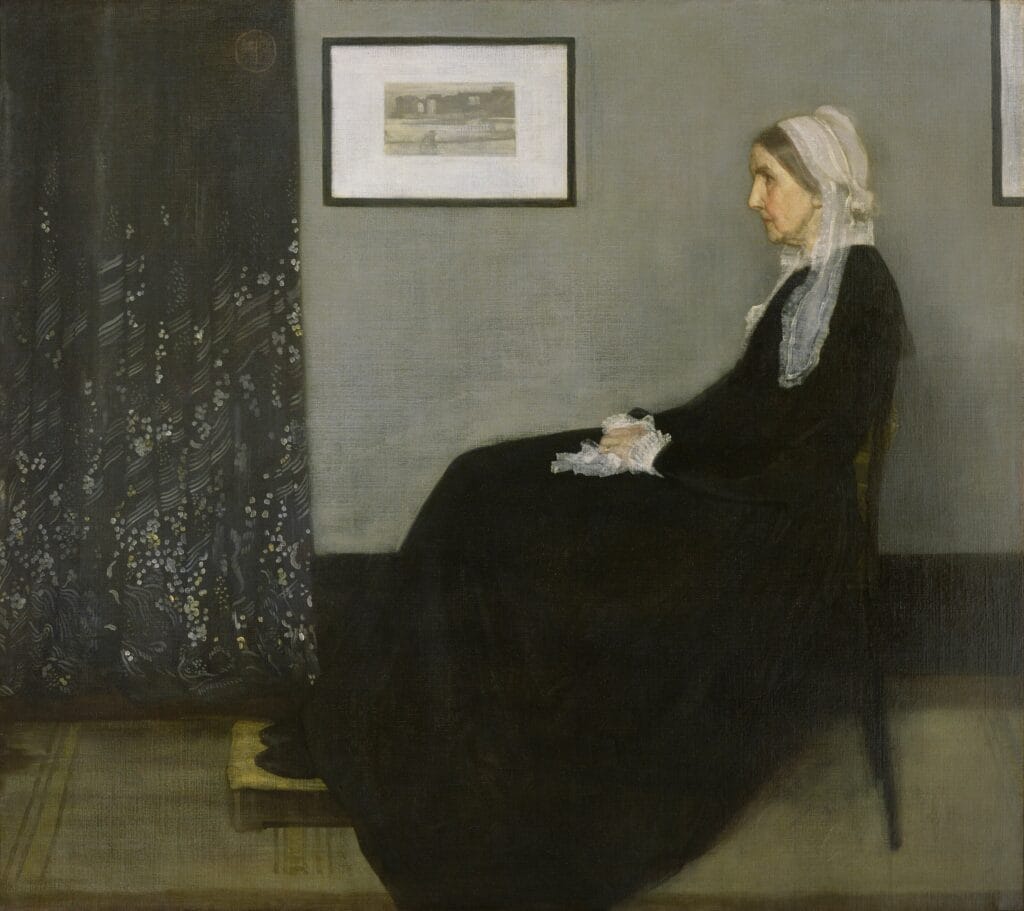
The most famous mother in art was painted because a model failed to turn up. James McNeill Whistler had planned to paint a young woman in his London studio in the summer of 1871; when she did not come, he asked his mother, who was living with him, to stand in. She was sixty-seven and found standing too tiring, so he sat her down in profile against the wall. The rest is one of the most reproduced images ever made.
Whistler himself would have been irritated by how it is remembered. To him it was not a portrait of his mother. It was an arrangement of grey and black.
The American who never went home
Whistler was born in Lowell, Massachusetts, in 1834. His father was a railway engineer who took the family to Russia to build the line between St Petersburg and Moscow, which is where the boy first took drawing lessons. He was later admitted to the military academy at West Point, did well at drawing and badly at almost everything else, and was dismissed after failing chemistry. He liked to say that if silicon had been a gas, he would have been a general.
After a short spell drawing maps for the US Coast Survey, he left for Paris in 1855 to become a painter, and never lived in America again. He settled in London, made his name as an etcher of the Thames, and cultivated a public persona — the monocle, the white forelock, the cane, the cutting remark — that was as carefully designed as any of his pictures.
The woman in white
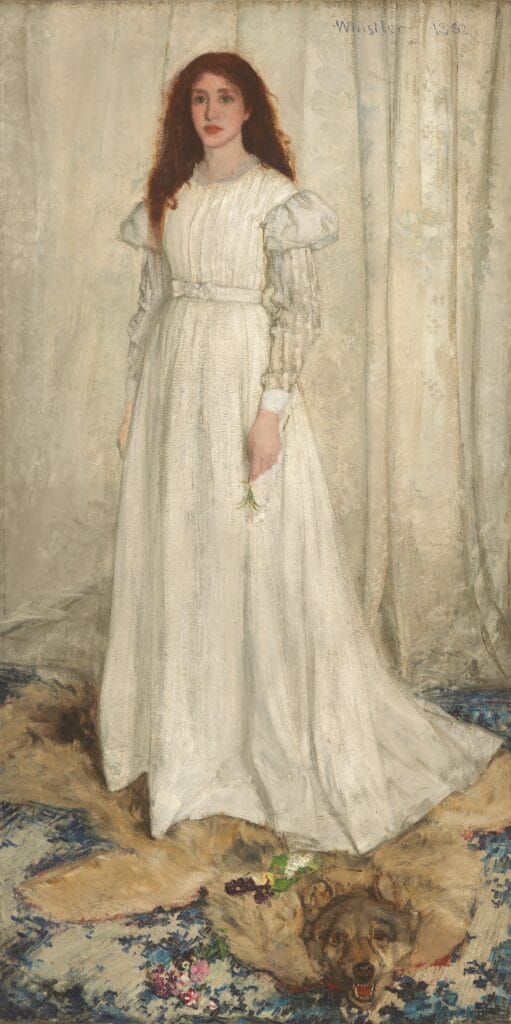
His first real scandal was Symphony in White, No. 1, painted in 1862. A young woman stands in a white dress against a white curtain, holding a lily, a wolf-skin rug at her feet. The model was Joanna Hiffernan, an Irishwoman who was his partner and favourite model for years.
The Royal Academy in London rejected it. So did the Paris Salon the following year. It was shown instead at the Salon des Refusés of 1863, the famous exhibition of rejected work where Manet’s Luncheon on the Grass also caused a stir, and drew crowds and jeers in roughly equal measure. Critics wanted to know who the woman was and what story the picture told. Whistler’s answer, more or less, was that there was no story — it was a study in white.
Painting as music
That idea became the centre of everything he did. He began giving his pictures musical titles — symphonies, harmonies, nocturnes, arrangements — to make the point that a painting, like a piece of music, could be about colour and form rather than about its subject. It was a radical position in Victorian England, where paintings were expected to tell stories and teach lessons.
So when he exhibited the portrait of his mother at the Royal Academy in 1872, it was titled Arrangement in Grey and Black No. 1. The Academy nearly rejected it too. It got in, by most accounts, only because one member threatened to resign if it was turned down.
Look at the wall, not the woman
Look at Whistler’s Mother with the title in mind and it changes. The figure is almost a flat black shape. The wall behind her is divided into precise rectangles of grey. The framed etching on the wall — one of Whistler’s own, of the Thames — and the patterned curtain on the left are placed with the care of a Japanese print, which he collected and admired.
It is extremely restrained, and that restraint is the point. There is almost no colour, no background detail to read, no expression to interpret. Everything is balance.
His mother, Anna, was a devout and rather formidable woman, and the stillness of the picture suits her. But Whistler always insisted the public should not care about her identity. It was his own family pride, and nobody else’s business.
The court case over a pot of paint
Whistler’s most famous moment came in 1878, in a courtroom. The critic John Ruskin, the most powerful voice in English art, had seen one of Whistler’s nocturnes — a dark, loose picture of fireworks falling over the Thames — and written that he never expected to hear a coxcomb ask two hundred guineas for flinging a pot of paint in the public’s face.
Whistler sued for libel. In court, Ruskin’s lawyer asked how long it had taken him to paint the picture. About two days, Whistler said. And for two days’ work he asked two hundred guineas? No, he replied — he asked it for the knowledge of a lifetime.
He won the case. The jury awarded him a single farthing in damages and no costs. The legal bills bankrupted him the following year.
How a mother became a mother
For years, Arrangement in Grey and Black was a picture Whistler could not sell. He even pawned it at one point. In 1891 the French state bought it for the national collection in Paris, which was a huge honour for an American painter, and it now hangs in the Musée d’Orsay.
Its afterlife in America is where the meaning changed. It toured the United States during the Depression and drew enormous crowds. In 1934 the US Post Office used it on a Mother’s Day stamp, adding a vase of flowers and the words “In memory and in honor of the mothers of America”. The picture Whistler insisted was not about motherhood became, for millions of people, the image of motherhood itself.
He died in London in 1903, by then famous, still combative, and still annoyed that people would not simply look at what he had painted.
Living with Whistler
Whistler’s two great figure paintings are opposites, and they make an unusually good pair.
Whistler’s Mother is 45 by 40 inches, nearly square, and all greys and blacks. It is calm and graphic and sits well in modern rooms — on white walls, against pale wood, near black furniture. It is one of the few old paintings that genuinely looks at home in a minimal interior.
Symphony in White, No. 1 is 27 by 54 inches, tall and narrow, almost all white. It suits a narrow wall, a stair, or the space beside a doorway, and on a warm white wall it seems to glow. Both are in Portraits & Figures.
Hang one, and you may find yourself doing exactly what Whistler wanted — looking at the shapes before you think about the people.